


Introduction
Learning objectives are clear, concise statements that describe what learners should know or be able to do by the end of a lesson, course, or training program. They guide both instructors and learners by setting measurable expectations for learning outcomes. Clear and well-defined learning objectives matter because they create focus, support effective lesson planning, and make it easier to evaluate whether learning goals have been successfully achieved.
One of the most powerful ways to strengthen learning objectives is by using precise learning objective verbs—action words that specify exactly what learners will accomplish. These verbs improve clarity, support accurate assessment, and help educators design aligned instructional activities. When learning objectives include strong, measurable verbs, they become easier to teach, track, and evaluate.
To choose the right verbs, educators often rely on Bloom’s Taxonomy, a widely used framework that categorizes cognitive skills from basic recall to higher-order thinking. Bloom’s Taxonomy provides a structured way to select verbs that match the level of learning you want students to achieve, ensuring consistency and effectiveness across your objectives.
What Are Learning Objective Verbs?
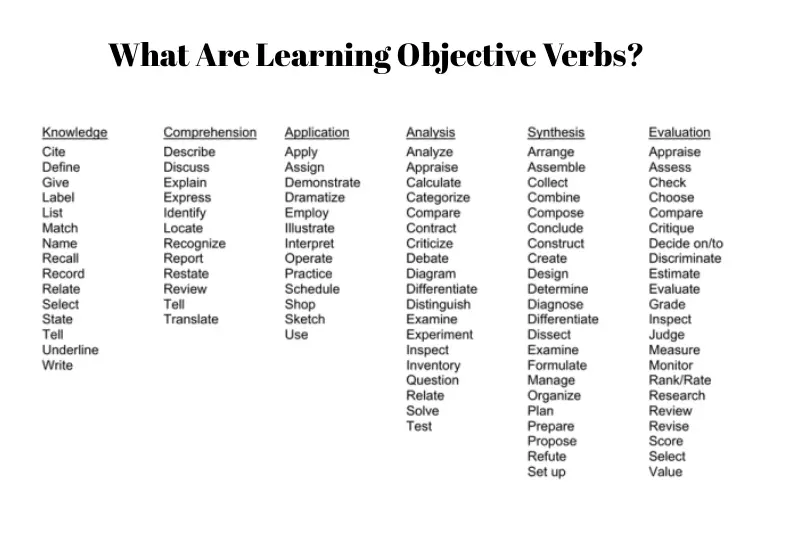
Learning objective verbs are action words used in educational objectives to clearly describe what learners are expected to do or achieve. Unlike vague terms such as “understand” or “know,” effective learning objective verbs are measurable and observable, making it easier to assess whether the learning goal has been accomplished.
For example, verbs like analyze, create, compare, and demonstrate indicate specific actions students should perform, helping both instructors and learners focus on tangible outcomes. By using precise verbs, educators can design lessons, activities, and assessments that align closely with the intended learning outcomes.
These verbs play a critical role in instructional design, as they help transform broad educational goals into actionable and measurable steps. When chosen thoughtfully, learning objective verbs bridge the gap between teaching intentions and student achievement, ensuring that learning is both targeted and trackable.
May be you like it:
Exams Quotes for Students – Motivational And Positive Exam Quotes
Education Theories – Types Importance, And Classroom Applications
Education Theorists – Key Thinkers and Learning Theories Shaping Modern Education
Learning in Spanish Translation – How to Say ‘Learning’ and Improve Your Spanish
Learning Multiplication – Fun Easy and Effective Ways for Kids to Master Times Tables
Why Learning Objective Verbs Matter

Using the right learning objective verbs is essential for creating effective and measurable learning outcomes. They do more than just describe what students should do—they shape the entire learning experience, from instruction to assessment.
Clarity in Learning Goals
Clear, action-oriented verbs eliminate ambiguity in learning objectives. Instead of saying “understand photosynthesis,” a more measurable objective would be “explain the process of photosynthesis.” This clarity helps students know exactly what is expected of them and allows teachers to communicate learning goals more effectively.
Measurable Assessment
Learning objective verbs make it easier to design assessments that directly measure student performance. Verbs like identify, analyze, and create correspond to observable actions that can be graded or evaluated, ensuring that assessments align with the intended learning outcomes.
Effective Instructional Design
When educators use precise verbs, they can plan activities and lessons that support specific learning objectives. For instance, a verb like compare might lead to activities that involve evaluating two case studies, while design could guide project-based learning tasks.
Alignment with Bloom’s Taxonomy
Choosing verbs based on Bloom’s Taxonomy ensures that objectives target the appropriate cognitive level—ranging from lower-order thinking skills, like remembering and understanding, to higher-order skills, such as analyzing, evaluating, and creating. This alignment guarantees that instruction, practice, and assessment work together to achieve the desired learning outcomes.
In short, learning objective verbs are more than words—they are tools that make teaching measurable, focused, and effective.
May be you like it:
Education in Russia – Top Universities Programs And Opportunities for International Students
Education is Important to Society Because It Matters
Education Benefits for Veterans – Maximize Your GI Bill Scholarships And Training
Learning Korean Alphabet – A Beginner’s Guide to Hangul
Teacher Appreciation Week 2026 – Dates, Ideas, and Ways to Celebrate
Common Learning Objective Verbs by Bloom’s Taxonomy Levels
Bloom’s Taxonomy is a widely used framework for categorizing learning objectives based on cognitive complexity. By aligning learning objective verbs with each level, educators can create objectives that are measurable, clear, and appropriate for the learners’ stage. Below is a breakdown of common verbs for each level of Bloom’s Taxonomy:
| Bloom’s Level | Description | Common Learning Objective Verbs |
|---|---|---|
| Remember | Recall facts, terms, and basic concepts | list, define, identify, recognize, name, describe, recall |
| Understand | Explain ideas or concepts | explain, summarize, paraphrase, classify, interpret, illustrate |
| Apply | Use information in new situations | demonstrate, use, solve, execute, implement, apply |
| Analyze | Break information into parts and explore relationships | compare, contrast, examine, differentiate, organize, distinguish |
| Evaluate | Make judgments based on criteria | assess, critique, justify, argue, evaluate, defend |
| Create | Produce new or original work | design, construct, formulate, plan, develop, compose |
Using these verbs ensures that learning objectives are specific, actionable, and measurable, which in turn improves teaching effectiveness and student outcomes. For example, instead of saying “students will understand photosynthesis,” you could say “students will explain the process of photosynthesis,” aligning with the Understand level of Bloom’s Taxonomy.
Tips for Choosing the Right Learning Objective Verbs
Selecting the right learning objective verbs is crucial for writing clear, measurable, and effective objectives. Here are practical tips to guide educators and instructional designers:
Align Verbs with Bloom’s Taxonomy
Start by identifying the cognitive level you want your learners to achieve. Lower-order skills like remembering or understanding require simpler verbs, while higher-order skills like analyzing, evaluating, or creating need action verbs that reflect critical thinking and problem-solving.
Make Objectives Measurable
Choose verbs that correspond to observable actions. Avoid vague verbs like know or learn, which cannot be directly assessed. Instead, use verbs such as demonstrate, classify, compare, or design, which clearly show what students are expected to do.
Match Verbs to Learning Activities
Ensure the verbs you select align with your instructional strategies. For example, if your activity involves group discussion, verbs like analyze, evaluate, or debate are appropriate. For hands-on tasks, verbs like construct, demonstrate, or assemble work best.
Consider the Audience and Context
Tailor verbs to the learners’ age, skill level, and context. For younger learners or beginners, simpler verbs like identify or describe may be appropriate. For advanced learners, use more complex verbs such as synthesize or design.
Limit to One Action Verb per Objective
Keep each learning objective focused by using a single verb. This ensures clarity, reduces confusion, and makes assessment straightforward. Multiple verbs in one objective can dilute focus and make measurement difficult.
By following these tips, educators can write precise, actionable, and measurable learning objectives that guide instruction, enhance student understanding, and support effective assessment.
May be you like it:
Teacher Jokes | 50+ Funny Jokes for Teachers, Students And Adults
Teacher from Fairly OddParents – Mr. Crocker And School Characters Explained
Teacher Incentive Allotment – Benefits, Types, and How It Works
Teacher Vanderbilt Form – Step-by-Step Guide for Accurate ADHD Assessment
Learning Objective Verbs – A Complete Guide with Examples And Tips
Examples of Learning Objective Verbs in Action
Seeing learning objective verbs in real sentences helps illustrate how they make objectives measurable, clear, and actionable. Here are examples across different Bloom’s Taxonomy levels and subject areas:
Remember
- Science: “Students will list the stages of the water cycle.”
- History: “Students will identify key events of the American Revolution.”
Understand
- Math: “Students will explain the steps to solve a linear equation.”
- Literature: “Students will summarize the main themes of the novel.”
Apply
- Technology: “Students will use spreadsheet formulas to calculate expenses.”
- Health: “Students will demonstrate proper handwashing techniques.”
Analyze
- Business: “Students will compare different marketing strategies and their effectiveness.”
- Biology: “Students will analyze the impact of environmental changes on ecosystems.”
Evaluate
- Education: “Students will assess the credibility of online sources.”
- Engineering: “Students will justify their choice of materials for the design project.”
Create
- Art: “Students will design a mural representing cultural diversity.”
- Computer Science: “Students will develop a mobile app prototype for a given problem.”
Using these verbs in objectives ensures that learning outcomes are specific, measurable, and aligned with instructional goals. They make it clear what students are expected to do, which in turn improves engagement and assessment accuracy.
Common Mistakes to Avoid When Choosing Learning Objective Verbs
While learning objective verbs are essential for creating clear and measurable objectives, educators often make mistakes that reduce their effectiveness. Avoiding these pitfalls ensures your learning objectives remain actionable and aligned with instructional goals.
Using Vague or Unmeasurable Verbs
Verbs like understand, know, or learn are too ambiguous and cannot be directly assessed. Instead, choose measurable verbs like describe, explain, or demonstrate that clearly show the expected outcome.
Using Too Many Verbs in One Objective
Including multiple action verbs in a single objective can create confusion and make assessment difficult. Focus on one primary verb per objective to maintain clarity and measurability.
Misaligning Verbs with Bloom’s Taxonomy
Choosing a verb that doesn’t match the intended cognitive level can lead to objectives that are either too easy or too advanced. For example, using list for a task meant to encourage critical thinking doesn’t challenge students to analyze or evaluate.
Ignoring the Learner’s Level
Not considering the age, skill level, or prior knowledge of learners can result in objectives that are unrealistic or too simplistic. Always tailor verbs to suit the audience’s abilities.
Focusing on Teacher Actions Instead of Student Outcomes
Objectives should describe what students will do, not what the teacher will teach. For example, “The teacher will explain photosynthesis” is less effective than “Students will explain the process of photosynthesis.”
By avoiding these common mistakes, educators can write clear, actionable, and measurable learning objectives that guide instruction, improve assessment accuracy, and enhance student learning outcomes.
Conclusion
Learning objective verbs are the backbone of clear, measurable, and effective learning outcomes. By choosing the right action words, educators can ensure that their objectives are specific, assessable, and aligned with both instructional goals and Bloom’s Taxonomy.
Using precise verbs not only clarifies what learners are expected to achieve but also guides lesson planning, instructional design, and assessment. From remembering and understanding to analyzing, evaluating, and creating, each verb plays a critical role in shaping the learning experience and promoting student success.
By avoiding common mistakes—such as using vague verbs or misaligning verbs with cognitive levels—teachers can write objectives that truly drive learning and measurable outcomes. With practice, selecting the right learning objective verbs becomes a powerful tool for enhancing education and achieving meaningful results.
May be you like it:
Learning Calculus Made Easy – Beginner’s Guide to Mastering Calculus
Examkrackers MCAT – Complete Guide to High-Yield MCAT Prep And Study Resources
Exams Crossword Clue – Tips Examples and Answers to Solve Crossword Puzzles
