


Calculus is one of the most powerful branches of mathematics, and learning calculus can open doors to understanding the world in a completely new way. From predicting how planets move to optimizing business strategies, calculus plays a critical role in solving real-world problems. For students and professionals alike, gaining a solid foundation in calculus is essential for academic success and practical applications in today’s fast-paced world.
At its core, calculus is the study of change and motion. It allows us to understand how quantities vary and accumulate over time, providing tools for analyzing complex systems that simple arithmetic or algebra cannot handle. Whether it’s calculating the trajectory of a rocket, modeling population growth, or determining the most efficient way to manufacture products, calculus offers insights that are impossible to achieve without it.
For calculus for beginners, starting with basic calculus concepts can make the learning process manageable and even enjoyable. By focusing on understanding calculus rather than just memorizing formulas, learners can develop the skills needed to tackle more advanced topics with confidence. Today, learning calculus isn’t just about numbers—it’s about unlocking problem-solving abilities that span science, engineering, economics, and technology.
What Is Calculus?
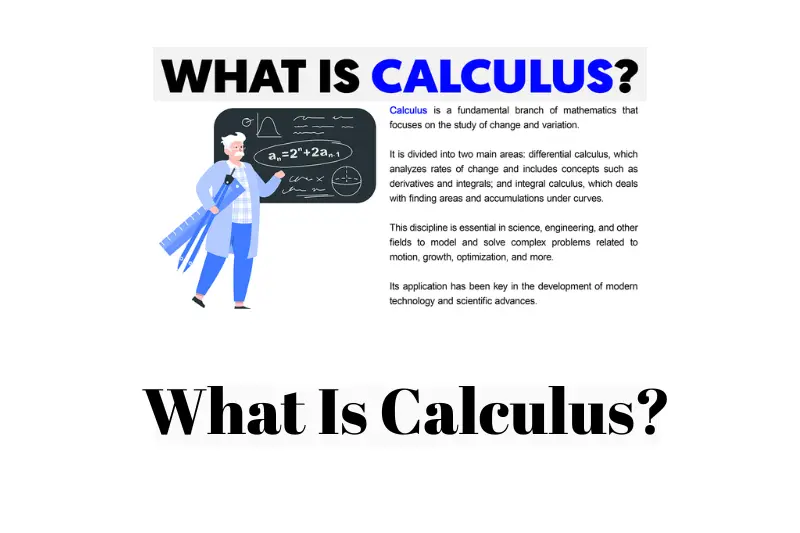
Calculus is a branch of mathematics that deals with change and motion, helping us understand how things vary over time or across different conditions. At its core, calculus is divided into two main areas: differential calculus and integral calculus. Differential calculus focuses on rates of change, such as how fast an object is moving at a given moment, while integral calculus is concerned with accumulation, like calculating the total distance traveled or the area under a curve.
For calculus for beginners, it’s important to start with the basic calculus concepts. These include limits, derivatives, integrals, and the fundamental theorem of calculus. Each concept builds on the previous one, so developing a clear understanding early on is crucial. By understanding calculus, learners can solve real-world problems with confidence and precision.
Calculus is more than just formulas and equations—it’s a tool that describes the world around us. Engineers use it to design bridges and aircraft, scientists apply it to study motion and forces, economists use it to analyze trends and optimize resources, and computer scientists implement calculus in algorithms and simulations. By learning calculus, beginners gain access to a powerful framework that explains both natural phenomena and human-made systems, making it an essential skill in many academic and professional fields.
May be you like it:
Exams Quotes for Students – Motivational And Positive Exam Quotes
Education Theories – Types Importance, And Classroom Applications
Education Theorists – Key Thinkers and Learning Theories Shaping Modern Education
Learning in Spanish Translation – How to Say ‘Learning’ and Improve Your Spanish
Learning Multiplication – Fun Easy and Effective Ways for Kids to Master Times Tables
Why Learning Calculus Is Important

Learning calculus is more than an academic requirement—it’s a gateway to understanding the world and solving complex problems. Calculus provides the tools to model and predict changes, which is essential in fields ranging from science and engineering to economics and technology. For instance, engineers use calculus to design safe bridges, optimize energy efficiency, and predict stress on materials. Scientists apply it to study motion, population growth, and even the behavior of subatomic particles.
In economics, calculus helps analyze trends, optimize profits, and make strategic decisions based on changing market conditions. Similarly, in technology and computer science, calculus underpins algorithms, machine learning models, and simulations that power innovations in artificial intelligence, robotics, and data analytics.
For calculus for beginners, appreciating these real-world applications makes the learning journey more meaningful. By understanding calculus, learners can see the practical impact of what might otherwise seem like abstract formulas. Developing a strong foundation in calculus concepts not only improves problem-solving skills but also builds logical thinking and analytical abilities. In short, learning calculus equips students and professionals with a versatile toolkit that’s indispensable across numerous disciplines today.
Key Calculus Concepts for Beginners
For anyone learning calculus, understanding the fundamental concepts is the first step toward mastering this powerful branch of mathematics. While calculus may seem intimidating at first, breaking it down into core ideas makes it much more approachable. For calculus for beginners, focusing on a few key concepts provides a strong foundation for more advanced topics.
- Limits and Continuity
Limits are the building blocks of calculus. They help us understand the behavior of functions as they approach a particular point. For example, the speed of a car at an exact moment can be analyzed using limits. Continuity ensures that a function behaves smoothly without sudden jumps, which is essential for applying other calculus concepts accurately. By understanding calculus, beginners can grasp why limits are crucial for defining derivatives and integrals. - Derivatives and Differentiation
Derivatives measure how a quantity changes relative to another. In simple terms, they describe the rate of change or slope of a function. For instance, a derivative can tell you how fast a population is growing or how quickly a car accelerates. Learning how to calculate derivatives and interpret their meaning is a central part of learning calculus and mastering calculus concepts. - Integrals and Integration
While derivatives break things down into rates of change, integrals do the opposite—they accumulate quantities over time or space. For example, integrals can calculate the area under a curve or determine total distance traveled. Understanding integration is vital for solving real-world problems in physics, engineering, and economics.
By focusing on these key concepts—limits, derivatives, and integrals—calculus for beginners becomes much more manageable. Emphasizing understanding calculus rather than memorizing formulas helps learners develop critical thinking skills and apply their knowledge to practical problems. With consistent practice, mastering these calculus concepts lays the groundwork for more advanced studies in mathematics, science, and technology.
May be you like it:
Education in Russia – Top Universities Programs And Opportunities for International Students
Education is Important to Society Because It Matters
Education Benefits for Veterans – Maximize Your GI Bill Scholarships And Training
Learning Korean Alphabet – A Beginner’s Guide to Hangul
Teacher Appreciation Week 2026 – Dates, Ideas, and Ways to Celebrate
Tips for Learning Calculus Effectively
Learning calculus can seem challenging at first, but with the right approach, it becomes much more manageable and even enjoyable. For calculus for beginners, adopting effective study strategies can make a big difference in understanding and retaining key concepts.
- Focus on Conceptual Understanding
Rather than memorizing formulas, prioritize understanding calculus concepts. Grasping why a derivative measures a rate of change or why an integral calculates accumulation helps you apply these ideas to real-world problems. Conceptual clarity makes advanced topics easier to learn later. - Practice Regularly
Consistent practice is crucial. Solving a variety of problems reinforces calculus concepts and builds confidence. Start with simple examples and gradually move to more complex applications. - Use Visual Aids
Graphs and diagrams make abstract ideas tangible. Visualizing how functions change or how areas accumulate under curves can improve comprehension and make learning calculus less intimidating. - Relate Calculus to Real-Life Applications
Connecting theory to practical scenarios—like tracking speed, optimizing resources, or modeling growth—makes learning meaningful and memorable. Seeing calculus in action motivates beginners to continue learning. - Leverage Resources
Online tutorials, textbooks, and interactive exercises are invaluable. Platforms like Khan Academy, MIT OpenCourseWare, and educational apps provide structured guidance for calculus for beginners.
By following these tips and emphasizing understanding calculus over rote memorization, learners can make steady progress. Effective study habits not only simplify calculus concepts but also build critical thinking and problem-solving skills essential in science, engineering, economics, and technology.
May be you like it:
Teacher Jokes | 50+ Funny Jokes for Teachers, Students And Adults
Teacher from Fairly OddParents – Mr. Crocker And School Characters Explained
Teacher Incentive Allotment – Benefits, Types, and How It Works
Teacher Vanderbilt Form – Step-by-Step Guide for Accurate ADHD Assessment
Learning Objective Verbs – A Complete Guide with Examples And Tips
Common Challenges of Learning Calculus
Weak Algebra & Pre-calculus Foundations
Calculus builds on algebra, trigonometry, and functions. If those fundamentals are shaky, limits and derivatives feel confusing.
Difficulty Understanding Abstract Concepts
Ideas like limits, infinitesimals, continuity, and instantaneous rate of change are not intuitive and can feel very abstract.
Struggling With Symbolic Notation
Calculus introduces new symbols ( lim, ∫, dx ) and notation rules. Many learners get lost because they don’t fully understand what the symbols represent.
Memorizing Instead of Understanding
Students often try to memorize formulas for derivatives or integrals instead of learning why they work, which leads to confusion on unfamiliar problems.
Jump in Problem-Solving Complexity
Calculus problems often require multiple steps and combining several concepts (e.g., chain rule + trigonometry + algebra), which can feel overwhelming.
Difficulty Visualizing Functions & Change
Many calculus topics require visual intuition—curves, slopes, areas, and rates of change—which can be challenging without graphing practice.
Applied Word Problems
Optimization, related rates, and real-world modeling problems require translating text into equations—one of the most common stumbling blocks.
Integration Is Especially Hard
Unlike differentiation, integration has no universal “one rule.” Choosing the correct method (substitution, parts, partial fractions) can be difficult.
Anxiety & Lack of Confidence in Math
Calculus has a reputation for being “hard,” which often increases stress and makes learning even more difficult.
Not Practicing Enough
Calculus is not learned passively. Without consistent practice and problem repetition, concepts don’t stick.
Conclusion
Learning calculus can be challenging, but most difficulties stem from gaps in foundational skills, unfamiliar abstract concepts, and the need for consistent practice. By strengthening algebra and pre-calculus basics, developing a solid understanding of core ideas like limits and derivatives, and practicing regularly, students can overcome these barriers. With the right approach, supportive resources, and persistence, calculus shifts from feeling overwhelming to becoming a powerful tool for understanding change, motion, and real-world problems.
May be you like it:
Learning Calculus Made Easy – Beginner’s Guide to Mastering Calculus
Examkrackers MCAT – Complete Guide to High-Yield MCAT Prep And Study Resources
Exams Crossword Clue – Tips Examples and Answers to Solve Crossword Puzzles
