

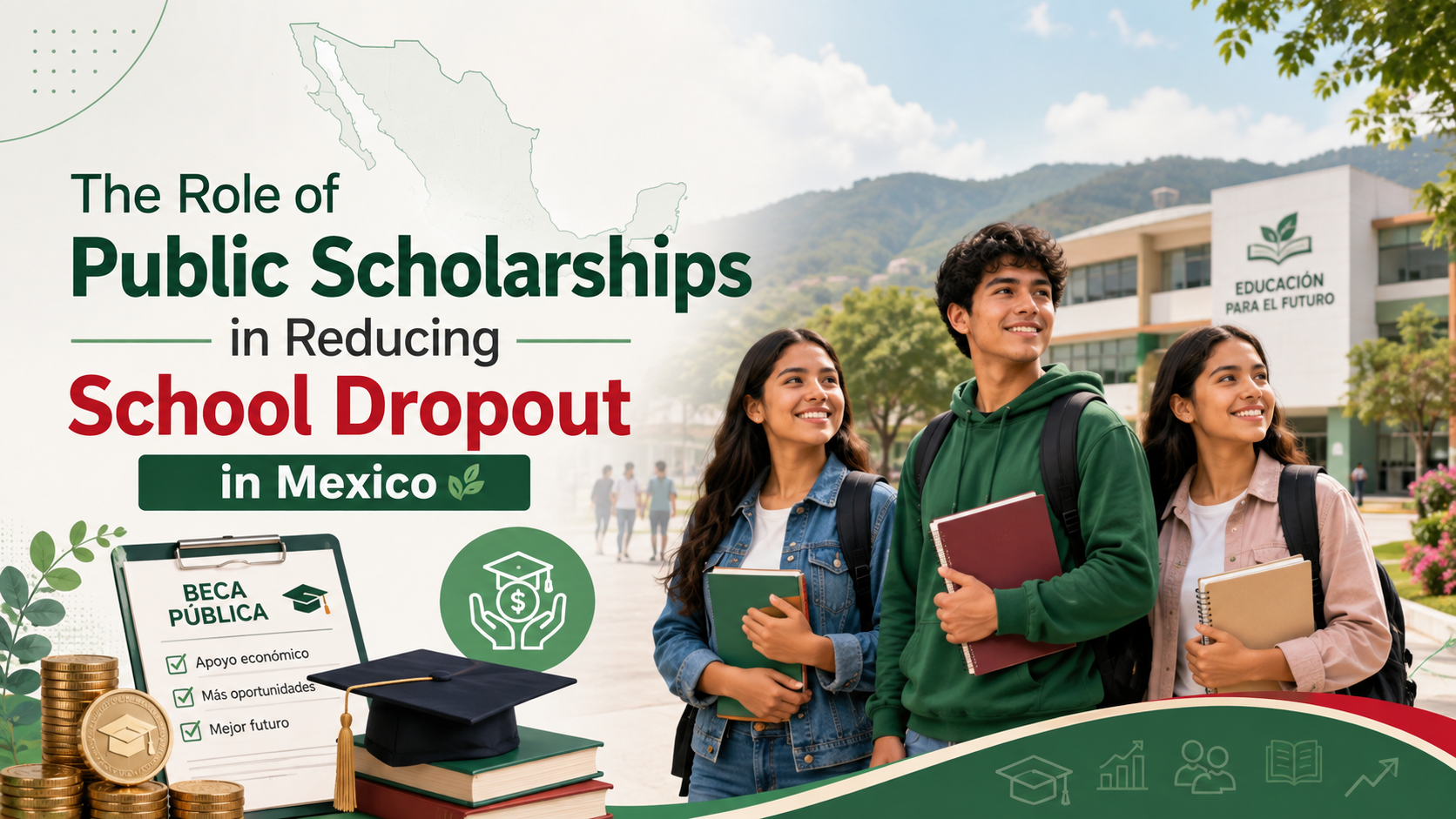
School dropout remains one of the most important challenges facing education systems around the world, and Mexico is no exception. For many students, leaving school is not simply a matter of poor academic performance or lack of interest. Economic pressure, transportation costs, family responsibilities, limited access to educational resources, and the need to work can all influence whether a young person continues studying.
In this context, public scholarships have become an important tool for improving educational continuity in Mexico. By providing financial support to students and families, government scholarship programs can reduce some of the economic pressures that often push learners out of school.
Although scholarships alone cannot solve every cause of school dropout, they can play a meaningful role in helping students remain enrolled, complete their studies, and continue toward higher levels of education.
Why Students Drop Out of School
School dropout is usually the result of several factors working together.
For some families, the direct and indirect costs of education can become difficult to manage. Even when public schooling does not require high tuition fees, families may still need to pay for transportation, uniforms, school supplies, internet access, meals, books, and other everyday expenses.
For low-income households, these costs can become significant.
As children grow older, another challenge may appear. Teenagers and young adults can face pressure to find employment and contribute to household income. In these situations, continuing secondary school or upper-secondary education may be seen as less urgent than earning money.
Other factors can also contribute to dropout, including:
- Long distances between homes and schools
- Family responsibilities
- Academic difficulties
- Limited access to technology
- Lack of transportation
- Changes in family income
- Migration
- Health or personal circumstances
- Low expectations about future employment
Because these challenges are complex, reducing school dropout requires a combination of educational, social, and financial support.
How Public Scholarships Can Help
Public scholarships aim to reduce the financial burden associated with education.
Instead of families carrying the entire cost of keeping a student in school, government assistance can provide additional resources that help cover everyday educational expenses.
In Mexico, scholarship initiatives have increasingly focused on students enrolled in different levels of public education. Programs may support children in basic education, students attending upper-secondary schools, and young people pursuing university or other forms of higher education.
For families searching for information about these programs, platforms such as Buscador de Estatus can help students understand scholarship-related processes, payment information, and administrative requirements connected with government educational support.
The most important purpose of these scholarships is not simply to provide money. Their broader role is to make continued education more financially realistic for households that may otherwise struggle to keep children and young people in school.
Reducing the Pressure to Leave School for Work
One of the strongest ways scholarships may help reduce dropout is by decreasing the immediate financial pressure on students.
A teenager from a low-income household may feel that finding a job is more useful than remaining in school. If a family is struggling with basic expenses, the potential income from employment can become difficult to ignore.
Financial assistance can help change this calculation.
When families receive educational support, students may have more opportunity to stay enrolled rather than leaving school early to earn money.
This does not mean scholarships completely eliminate the need for students to work. However, even partial financial assistance can reduce the urgency of choosing employment over education.
Over time, completing upper-secondary school or continuing into higher education may provide young people with stronger employment opportunities than leaving the education system at an early age.
Supporting Everyday Education Costs
A common misunderstanding is that attending public school is completely free.
In reality, students and families often face many additional expenses.
Transportation can be particularly important in rural communities or areas where schools are far from students’ homes. Families may also need to purchase notebooks, uniforms, digital devices, mobile data, or other learning materials.
A scholarship can help households absorb these costs.
For example, financial support may allow a family to pay for regular transportation rather than having a student miss classes. It may help purchase internet access needed for homework or cover basic school materials at the beginning of an academic term.
These may appear to be small expenses individually, but together they can influence whether a student participates consistently in education.
Helping Students During Critical Educational Transitions
Dropout risk can increase when students move from one educational stage to another.
The transition from lower secondary education to upper-secondary school can be particularly important because students are older, educational expenses may increase, and employment becomes a more realistic alternative.
The transition from upper-secondary education to university creates another set of challenges.
Students may need to relocate, travel longer distances, purchase specialised materials, or pay for accommodation.
Public scholarship programs targeted at different education levels can help create greater continuity between these stages.
When financial assistance is available throughout a student’s educational journey, families may be more willing and able to view education as a long-term path rather than something that ends once costs become difficult to manage.
Scholarships and Educational Equality
Public scholarships also have a broader role in promoting educational equality.
Students do not begin their education with the same economic resources.
Some families can comfortably pay for transportation, private tutoring, laptops, books, and university preparation. Others may struggle to cover basic school expenses.
Without financial support, these inequalities can influence who remains in education and who leaves early.
Scholarships can help narrow part of this gap by directing resources toward students who need additional support.
This is particularly relevant in communities facing poverty, rural isolation, limited infrastructure, or fewer educational opportunities.
Improving access to financial assistance does not remove every inequality within the education system, but it can help ensure that household income is not the only factor determining whether a student continues studying.
The Importance of Reliable Scholarship Information
Another important issue is access to information.
A scholarship cannot support a student who does not know it exists or does not understand how to apply.
Families may need information about registration periods, eligibility criteria, required documents, payment schedules, application status, and official communication channels.
Confusion about these processes can sometimes prevent eligible students from receiving support.
For this reason, clear and accessible information is an important part of any scholarship system.
Schools, government institutions, community organisations, and trusted educational websites can all contribute by helping families understand available opportunities and avoid misinformation.
Students should also rely on official sources when submitting personal information or completing scholarship procedures.
Scholarships Must Be Part of a Wider Strategy
Although public scholarships are valuable, financial support alone cannot eliminate school dropout.
A student may continue facing academic difficulties, family problems, poor transportation, unsafe school environments, limited internet access, or uncertainty about future career opportunities.
Reducing dropout therefore requires a broader strategy.
Schools may need to provide academic tutoring, counselling, career guidance, mentoring, and early intervention for students who begin missing classes.
Communities may need improved transportation or digital infrastructure.
Families may benefit from greater awareness of the long-term value of education.
Scholarships are most effective when they operate alongside these other forms of support.
Long-Term Benefits for Students and Society
Helping students remain in education can have benefits that extend far beyond the classroom.
Young people who complete secondary and higher education may have access to a wider range of employment opportunities and professional careers.
Higher educational attainment can also strengthen household income, improve social mobility, and contribute to the development of skilled workers across different sectors of the Mexican economy.
There may also be broader community benefits.
When more students complete their education, communities can gain future teachers, healthcare workers, engineers, technicians, entrepreneurs, public servants, and other professionals.
Public investment in scholarships can therefore be understood not only as support for individual students but also as an investment in Mexico’s long-term social and economic development.
Conclusion
Public scholarships can help reduce school dropout in Mexico by easing financial pressure on families and supporting essential costs such as transport, materials, and technology. Their impact is strongest when combined with academic support, reliable information, and accessible school services. By making education more affordable, these programs give more students the chance to stay in school, complete their studies, and build better futures.
