

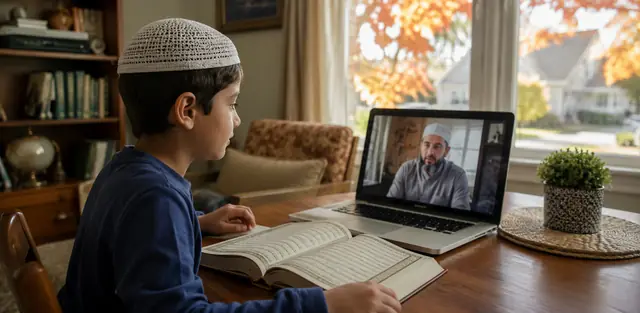
Thanks to online Quran classes in USA, parents can connect their children with experienced, Ijazah-certified teachers from anywhere in the country without being limited by location or local availability. However, with so many options available, choosing the right teacher requires careful consideration.
Here are the most important factors every parent should evaluate before enrolling their child.
Look for Ijazah Certification
One of the first questions to ask any Quran teacher is whether they hold an Ijazah.
An Ijazah is a formal certification that confirms a teacher has mastered Quran recitation with proper Tajweed and has been authorized to teach through an authentic chain of transmission that traces back to the Prophet Muhammad ﷺ.
While teaching experience is important, an Ijazah provides additional confidence that the teacher’s recitation has been carefully verified according to the traditional standards of Islamic scholarship.
Choose Someone Who Knows How to Teach Children
A beautiful recitation does not automatically make someone an effective teacher.
Children learn best from instructors who understand how to explain concepts clearly, encourage participation, maintain attention, and adapt lessons to different learning styles.
When evaluating a teacher, ask:
- How many years have you taught children?
- Do you specialize in one-on-one online lessons?
- How do you encourage students who lose motivation?
- How do you communicate progress with parents?
Experience working with children is just as valuable as technical knowledge.
Verify Educational Background
Many respected Quran teachers have studied at recognized Islamic institutions such as Al-Azhar University or other established centers of Islamic learning.
Although formal education alone does not guarantee excellent teaching, it demonstrates structured Islamic training and a solid foundation in Quranic sciences.
Parents should also look for teachers who continue improving their knowledge through ongoing study and teaching experience.
Never Skip the Trial Lesson
A free trial class is one of the most valuable parts of choosing a teacher.
During the lesson, observe how the teacher interacts with your child.
Do they:
- Correct pronunciation gently and clearly?
- Encourage participation?
- Explain mistakes patiently?
- Keep your child engaged throughout the lesson?
Afterward, ask your child whether they felt comfortable and whether they would like to learn with that teacher again.
A positive teacher-student relationship often determines long-term success more than qualifications alone.
Watch for Common Red Flags
Not every online Quran platform offers the same level of quality.
Parents should be cautious if:
- Teacher qualifications cannot be verified.
- The platform frequently changes teachers.
- Parents receive little or no progress updates.
- Class sizes are too large for meaningful interaction.
- Pricing seems unusually low without explaining teacher credentials.
Transparency, consistency, and communication are all signs of a well-managed Quran academy.
Choose Flexible Scheduling
Family routines vary, especially across different states and time zones in the USA.
A quality online Quran program should offer flexible scheduling that fits around school hours, extracurricular activities, family commitments, and weekends.
Consistent attendance becomes much easier when classes are scheduled at times that suit the child’s daily routine.
Learn with Quran Mentors
For families looking for experienced Quran teachers, Quran Mentors has been providing live one-on-one Quran education since 2018. Serving students across 130+ countries, the academy offers Ijazah-certified male and female teachers specializing in Quran reading, Tajweed, Hifz, Tafseer, Noorani Qaida, Arabic, and Islamic Studies.
Parents can also Learn Quran Online through a free trial class, meet a qualified teacher, receive a personalized assessment, and choose a learning plan based on their child’s age, current level, and educational goals.
Final Thoughts
Finding the right Quran teacher is one of the most important educational decisions a Muslim family can make.
By choosing a qualified instructor, verifying their credentials, and ensuring they are the right fit for your child’s learning style, parents can build a strong foundation for lifelong Quran education. With the right guidance, consistent practice, and supportive teaching, children can develop confidence, improve their recitation, and strengthen their relationship with the Quran for years to come.
