

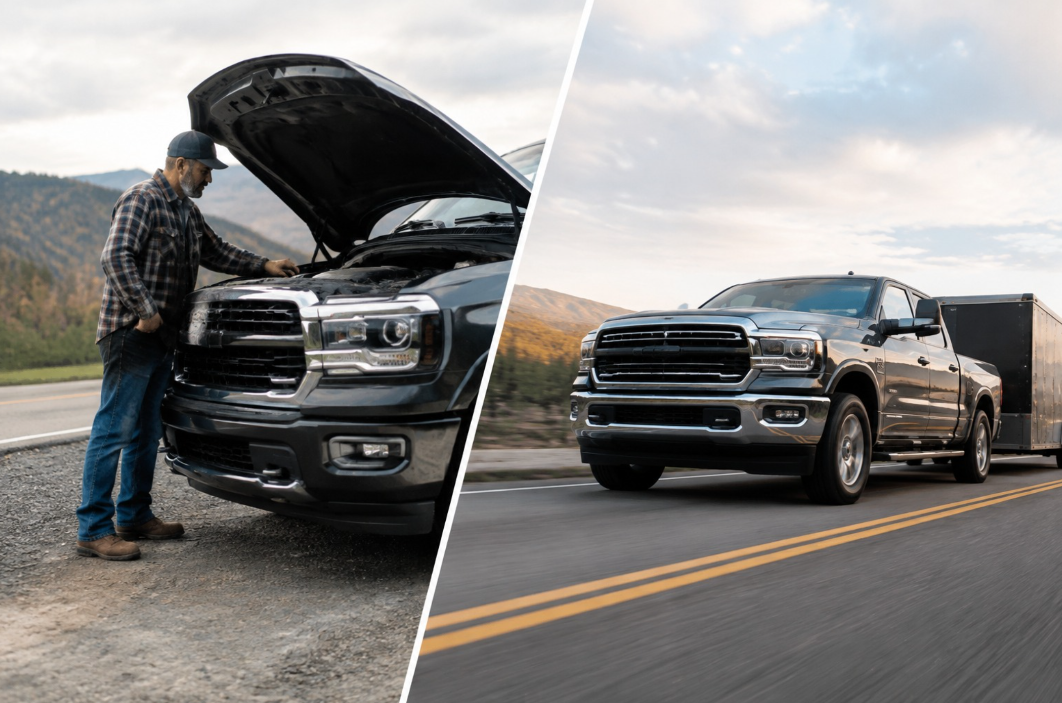
A 5-speed or 8-speed automatic doesn’t send a warning card before it quits. It just quits, usually on a Monday, usually with a loaded trailer behind it. I’ve pulled enough Chrysler transmissions out of Rams to know the pattern by heart.
So if you’re driving a Ram 1500 or 2500 to a job site every day, and the factory powertrain coverage is running out, a Dodge Extended Warranty isn’t some abstract add-on. It’s a decision with a deadline. Lenders, dealers, and mailers all want your attention right now, and most of them sound alike.
Here’s what most owners miss. Not every tier of coverage fits a truck that racks up 20,000 miles a year (or tows every weekend). Some plans protect the parts that actually fail on these trucks. Others protect parts that rarely do. And that gap matters more in 2026, with trucks aging into the exact mileage range where the expensive repairs start showing up.
Why Rams and Chargers Break Differently Once the Factory Warranty Runs Out
A 2019 Ram 2500 pulls a 9,000-pound gooseneck up a grade at 62,000 miles. The transmission shudders on the downshift, then the dash lights up. Nothing fancy. Just a truck doing the job it was bought for, one week after the 5-year, 60,000-mile powertrain coverage ended.
That story shows up in shops constantly. And a Dodge Extended Warranty conversation usually starts right there, not before.
What the Factory Powertrain Warranty Actually Stops Covering
Mileage cuts it off first. Time is second. Commuters and haulers blow through 60,000 miles in three years, so the coverage dies long before the calendar says it should.
Once it ends, you’re on your own for the engine, the automatic transmission, the transfer case, and both axles (yes, even the ones that haven’t made a sound yet). Bumper-to-bumper expired even earlier, usually at 36,000.
The Failure Points a Mechanic Sees Most Between 60,000 and 150,000 Miles
Here’s what actually lands on the lift:
- Automatic transmissions: worn clutch packs and valve body trouble, especially on trucks that tow.
- Transfer cases: chain stretch and shift motor failures on 4×4 models.
- Rear axle and differential: bearing wear from heavy payloads.
- Electronic modules: a transmission control module can quit with no warning.
- Cooling parts: water pumps and radiators on high-idle work trucks.
Which of those could you cover out of pocket on a Tuesday morning?
Powertrain, Essential, Premium, or Exclusionary: Matching the Dodge Extended Warranty Tier to Your Daily Miles
Mileage decides the tier. Not brand loyalty, not a sales pitch. A Ram that racks up 25,000 miles a year burns through factory coverage fast, and a Dodge Extended Warranty only helps if the tier matches what actually breaks.
When Powertrain Coverage Is Enough for a Ram 1500 or 2500
If the truck’s mostly highway miles and you keep up on fluid changes, powertrain does the job. It covers the engine, transmission, transfer case, and axles. Those are the big-ticket failures I’ve seen on 6-speed and 8-speed units (torque converters and valve bodies top the list). Cheap to carry, and it hits the repairs that sideline a work truck.
When Stepping Up to Essential or Premium Pays Off
But towing changes the math. Heavy loads cook cooling systems, wear steering gear, and chew through alternators.
- Essential adds cooling, brakes, steering, A/C, and fuel system parts.
- Premium adds suspension, ABS, and high-tech electronics.
Running a 2500 with a loaded trailer? Premium makes sense once you pass 80,000 miles, because front-end parts take the beating.
Why Exclusionary Coverage Suits Newer, Electronics-Heavy Dodge Models
Newer Rams are rolling computers. Big touchscreens, body control modules, adaptive cruise, air suspension. Stated-component plans can leave gaps there. Exclusionary coverage flips it: everything is covered except a short exclusion list, like brake pads, tires, and wipers. Closest thing to a factory warranty. Worth it?
For a late-model truck you depend on every day, usually yes.
Dealer Plan or Third-Party Vehicle Service Contract: Where Can You Actually Get Repairs Done?
Where does your Ram go when the transmission starts slipping on a Tuesday morning? That’s the question most owners skip until it’s too late. With a Dodge extended warranty sold through a dealer, the answer is often ‘the dealer, and only the dealer.’ Third-party contracts can work differently.
Repair Shop Flexibility and What It Means for a Truck You Can’t Park
Dealer-backed plans usually tie you to a brand service bay. That’s fine if one sits ten minutes from your job site. Out on a haul, it isn’t.
A third-party vehicle service contract that accepts any ASE-certified shop changes the math. After 25 years of rebuilding Chrysler transmissions, I’ll say it plainly: the mechanic who already knows your truck’s history usually diagnoses it faster. Ask three things before you sign:
- Can I pick my own ASE-certified shop?
- Does the provider pay the shop directly?
- Does coverage work in all 50 states while I’m towing?
Rental Car and Roadside Benefits for a Commuter Who Can’t Miss Work
A broken truck costs more than the repair. Missed shifts, a stalled trailer, a rental you’re covering yourself (that adds up quickly).
Look for rental reimbursement, towing to a qualified shop, and trip interruption coverage for hotel and meals if you break down far from home. Not every plan includes them. Check the contract.
Reading the Contract Before You Sign: Timing, Maintenance Records, and Red Flags
Roughly 3 out of 4 denied claims on trucks I’ve seen trace back to paperwork, not parts. A bad transmission wasn’t the problem. Missing oil change receipts were.
The Best Window to Buy Before the Factory Coverage Ends
Buy 30 to 90 days before your 5-year/100,000-mile powertrain coverage runs out. Not after. Wait until the Ram is out of warranty and you’ll hit waiting periods (usually 30 days or 1,000 miles) with nothing underneath you, and anything that’s already acting up gets tagged as pre-existing.
A Cummins or Hemi pulling a 10,000-pound trailer doesn’t give you a polite heads-up before a transmission starts slipping. So don’t gamble on the last week.
Contract Terms That Matter More Than Marketing
Skip the glossy brochure. Read the actual contract during the money-back window and check these:
- Repair shop choice. Any ASE-certified shop beats dealer-only. Your local mechanic knows your truck.
- Towing and hauling language. Some contracts quietly exclude commercial use or overloaded towing. Ask directly.
- Maintenance proof. Keep every receipt for oil, transmission fluid, and diff service. A shoebox works fine.
- Stated versus exclusionary. Exclusionary lists what’s not covered, which is easier to read than a 60-item component list.
- Transferability. It helps resale value.
Any rep who dodges these questions?
Walk away.
Here’s the short version. A Ram that racks up 25,000 miles a year doesn’t wait around for the bad news. Transmissions, transfer cases, and the electronics that run them tend to quit somewhere past 60,000 miles, and the factory powertrain coverage is usually gone by then.
So the tier question comes down to what your truck actually does. A paid-off Ram 1500 with simple hardware can live on powertrain coverage. A newer 2500 loaded with modules and sensors? That’s a different animal, and a plan that only lists a handful of parts won’t catch most of what breaks. Match the plan to the truck, not to the sales pitch.
Where the truck gets fixed matters just as much. A commuter who can’t park for a week needs a plan that lets the shop he already trusts do the work, plus a rental on the days it’s down.
Any Dodge Extended Warranty worth owning should hold up to a close read. Before the factory coverage ends, pull your service records, request the full contract from two or three providers, and read the exclusions page first. Do that this month, while you still have options.
