

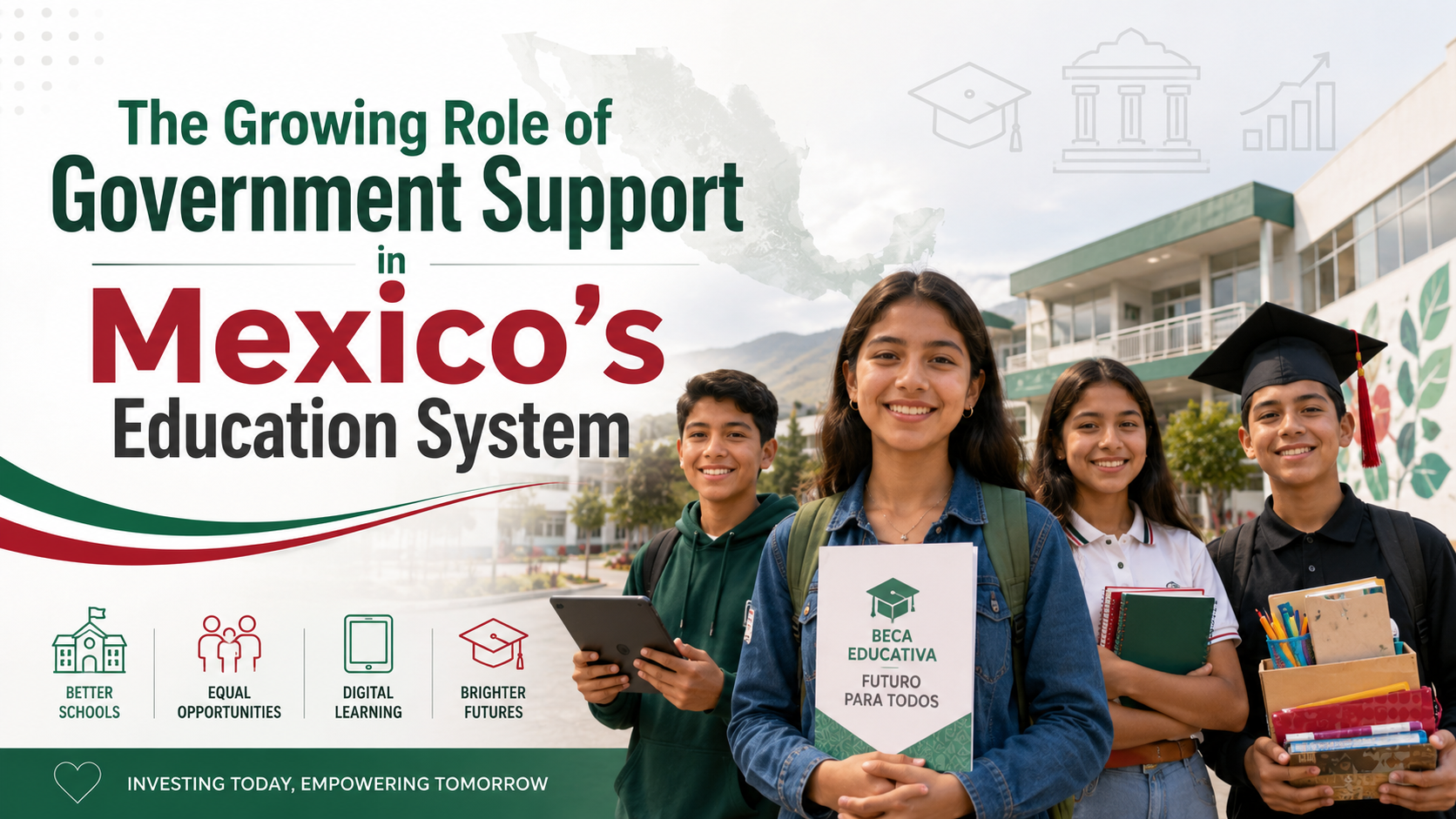
Education has always been one of the most important foundations for social and economic development. In Mexico, however, access to education is influenced by much more than the availability of schools. Household income, transportation, school supplies, digital access, infrastructure, and the distance between students and educational institutions can all affect whether a child or young person is able to remain in school.
For this reason, government involvement in education increasingly extends beyond operating schools and paying teachers. Public support now includes scholarships, financial assistance, improvements to school infrastructure, community-based education, digital learning resources, and programmes aimed at reducing educational inequality.
Mexico’s current education-support system demonstrates how government initiatives can address different barriers at different stages of a student’s journey.
Financial Support Has Become an Important Part of Education Policy
One of the clearest examples of government involvement is the expansion of student financial support.
For many Mexican families, the cost of education does not end simply because a child attends a public school. Families may still need to pay for transportation, uniforms, school materials, food, internet access, and other daily expenses.
These costs can become particularly difficult for households with several children in education.
Government scholarship programmes are designed to reduce some of this pressure. Mexico currently operates major scholarship initiatives across different educational stages, including the Rita Cetina Scholarship for basic education, the Benito Juárez Scholarship for upper-secondary education, and Jóvenes Escribiendo el Futuro for eligible students in higher education.
This creates a broader system of financial support rather than limiting assistance to a single stage of education.
The importance of these programmes goes beyond the amount of money received. For some families, financial assistance can help make it easier for students to continue attending school instead of facing pressure to interrupt their studies because of household expenses.
Supporting Students at Different Educational Stages
Students face different challenges depending on their age and level of education.
A family with children in primary or secondary school may be concerned about everyday school expenses. An upper-secondary student may have higher transportation or technology costs, while a university student may need to consider accommodation, study materials, and living expenses in addition to academic costs.
Government support therefore becomes more effective when it recognises that educational needs change throughout a student’s journey.
The Rita Cetina Scholarship, for example, provides economic support to families with students enrolled in public basic education. Meanwhile, other federal scholarship programmes focus on upper-secondary and higher-education students.
This wider approach reflects an important principle: access to education is not achieved simply by helping children enter school. Students also need conditions that make it possible to remain, progress, and eventually complete their education.
Government Support Is About More Than Scholarships
Scholarships often receive the most public attention because they provide direct assistance to students and families. However, educational opportunity also depends on the quality and condition of schools themselves.
A student may receive financial support and still study in a school that needs repairs, improved sanitation, better furniture, or other essential facilities.
This is where programmes such as La Escuela es Nuestra play a different role.
Rather than giving support directly to individual students, La Escuela es Nuestra involves school communities through committees that participate in decisions about how resources should be used to improve public educational spaces.
This highlights an important distinction in education policy.
Student support helps individuals overcome financial barriers, while school investment improves the environment in which education takes place.
Both are necessary if the goal is to create meaningful educational opportunity.
Reaching Rural and Marginalised Communities
Geography remains another important factor in educational access across Mexico.
Students living in large cities may have several schools within a relatively small area. In remote communities, the situation can be very different. Long distances, smaller populations, limited transportation, and fewer educational facilities can make traditional school models harder to maintain.
Government support therefore needs to adapt to local conditions.
The Consejo Nacional de Fomento Educativo (CONAFE) provides community-based initial and basic education in some of Mexico’s most remote and marginalised communities.
This type of programme demonstrates why educational equality cannot always mean providing exactly the same solution everywhere.
A densely populated urban community and a small rural settlement may have very different educational needs. Expanding access therefore requires flexible approaches that recognise geography, local resources, language, culture, and community circumstances.
Digital Access Is Becoming Part of Educational Support
Technology has also changed what students need in order to participate fully in education.
Internet access, digital learning materials, online research, educational platforms, and communication tools are now part of everyday learning for many students. This means that educational inequality can also become digital inequality.
Government-supported digital resources can help reduce this gap by making educational material available outside traditional textbooks and classrooms.
The digital platform of the Nueva Escuela Mexicana, for example, offers educational resources across multiple school levels as part of the wider public education ecosystem.
Digital resources cannot replace teachers, suitable schools, or reliable internet connectivity. However, they can expand access to learning materials and provide additional support for students, teachers, and families.
As education becomes increasingly connected to technology, digital inclusion is likely to remain an important part of discussions about equal educational opportunity.
Why Clear Information Matters
Creating government programmes is only one part of the challenge. Families must also understand how those programmes work.
Scholarships and other forms of assistance may involve eligibility rules, registration periods, documentation, school records, identity information, and payment procedures. Students and parents therefore need reliable information to understand what support may be available and what steps they need to follow.
Confusion can create unnecessary problems.
A family that misses an application period, provides incorrect information, or relies on outdated guidance may have difficulty accessing assistance even when a student could otherwise qualify.
For this reason, government agencies, schools, educational institutions, and reliable information platforms all have an important role in making processes easier to understand.
Students and families should also verify important scholarship and programme information through official government channels, particularly when rules, registration dates, or payment schedules can change.
Government Support Can Promote Educational Continuity
One of the most important goals of education policy is not simply increasing enrollment but helping students continue their studies.
There are many reasons why students may leave education early. Financial pressure is one factor, but transportation difficulties, family responsibilities, poor infrastructure, lack of academic support, and limited access to nearby institutions can also contribute.
No single government programme can solve all of these problems.
Scholarships can reduce household financial pressure. Infrastructure programmes can improve schools. Community education can reach remote populations. Digital platforms can expand access to educational materials.
When these approaches work together, they create a broader support system around the student.
That broader system is important because educational success depends on several conditions being present at the same time.
Supporting Families as Well as Students
Government education assistance also has an indirect impact on families.
When households spend a significant share of their income on transportation, supplies, technology, and other school-related expenses, educational costs can affect the entire family budget.
Financial assistance can help families manage some of these costs while keeping children connected to education.
This is particularly significant when several children within the same household are studying simultaneously.
In this sense, education programmes can function both as student support and family support. By reducing some education-related expenses, they can help create more stable conditions for students to continue learning.
Building a More Inclusive Education System
Mexico is a large and diverse country, which means students do not experience education in the same way.
A university student in a major city, a teenager in a rural community, and a child attending a public primary school may face very different barriers.
Effective government support must therefore be broad enough to address these differences.
Financial assistance is important, but so are infrastructure, teacher support, digital resources, community participation, and educational services that reach populations where conventional approaches may be difficult.
The growing role of government support reflects a wider understanding that the right to education requires more than simply providing a classroom.
Students must also have a realistic opportunity to access that classroom, remain in education, obtain the resources they need, and progress through different levels of learning.
Conclusion
Government support is playing a growing role in Mexico’s education system by addressing financial, geographic, and infrastructure barriers. Scholarships, school improvement programs, community education, and digital resources work together to help students access and continue their studies. The key challenge is ensuring that families can easily understand and benefit from this support, creating stronger opportunities for students to succeed.
